
English Language
English Dept. is one of the most significant departments at College of Education of Salahaddin university Erbil, being established in 1998. It offers a four-year undergraduate BA program to school graduates. Graduates from this department are awarded BA in English Language. Ever since its establishment thousands of students have graduated from this department, and they have become English language teachers at both government and non-government schools and institutions. This popularity has increased over the years, and now nearly 500 hundred students are enrolled in this department. Over the past decade, the department has also offered postgraduate programs including Higher Diploma (Hdip), Master of Arts (MA), and Doctorate of Philosophy (PhD).
This program offers the students both language proficiency modules as well as modules in the sub-fields of linguistics, literature and applied linguistics. These modules, backed up by latest theories and developments in the field, are designed to enhance both theoretical and practical knowledge of the students. Toward the end of the programme, students undertake a one-month teaching practicum course at local secondary and high schools under the mentorship of the department’s faculty members. Prior to graduation, students are also required to undertake a research project in any English language related topic under the supervision of a faculty member.
Recently, as part of the new policy of Salahaddin University Erbil SUE, English Department, along with all the other departments at college, is implementing the Bologna process in its all the stages study programs.
English Department curriculum constantly undergo development and changes to meet the needs of our students and to respond to the needs of the market place and the context as a whole. One instance of this development is the addition of three contemporary modules in its study programs including Artificial Intelligence (AI), entrepreneurship and Diversity education.
English Department has also evening shift that admits students with less rigid admission requirements compared to those of the morning shift in terms of school grades and age of the applicants.
Personal Information
Name: Dr. Dilovan Sayfuddin Saady Ghafoory
Academic Title: Assistant Professor
Email: [email protected]
Mobile: 0750 467 2661
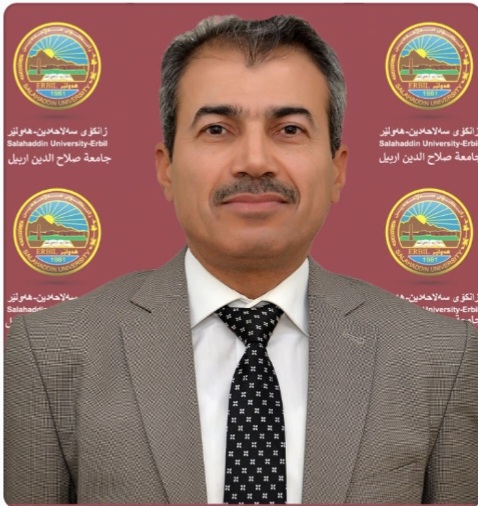
Dr. Dilovan Sayfuddin Saady Ghafoory
Education: PH D , Salahaddin University, English, 2010
Qualifications
- Teaching qualifications.
- IT qualifications: computer proficiency exam certificate.
- Language qualifications such as TOEFL, IELTS or any equivalent.
- Teaching English teacher training.
Teaching experience:
- Undergraduate: Syntax, morphology and Semantics.
- Postgraduate: Sociolinguistics, Phonetics and Phonology, Research Methods.
Research and publications:
- Animal Metaphor in English and Kurdish languages.
- Reduced Clauses in English and Kurdish languages.
- Realisation of Constituents in English and Kurdish languages.
- Presupposition Triggers in the types of presupposition used by Non-Native writers of English.
- Complex Symbols in English and Kurdish languages.
Funding and academic awards :
- Cincinnati University in Ohio in USA.
- IATEFL conference in Liverpool in Britain in 2013.
The mission of this department is to prepare English language teachers to teach at secondary and high schools in the region in both government and private sectors. These English language educators are meant to be pedagogically competent, culturally responsive, and committed to excellence in language teaching. Through a balance of theoretical knowledge and practical experience, this department is committed to enhance English language education in local and regional contexts.
The department designs a curriculum to graduate teachers who are equipped not only with the necessary research skills and knowledge required in the market but also with the necessary critical and creative thinking abilities that help the students to become a life-long learners after their graduation.
The mission has recently broadened to include a focus on Artificial Intelligence (AI), entrepreneurship, and diversity education. Our goal is to equip graduates with the knowledge and skills to effectively use AI both as learners of the target language and as future educators. They will learn to integrate AI into their teaching practices to enhance language instruction. In addition, the program fosters entrepreneurial thinking and a deep understanding of diversity, preparing graduates to become innovative, inclusive, and adaptable educators in a global context.
By the end of the program students will be able to:
- Gain proficiency in all the four skills of English language (speaking, listening, reading and writing).
- Gain Competency in the English language teaching profession by being able to plan lessons, design materials, deliver lessons and assess the learning outcomes.
- Conduct small scale research on topics related to English language including linguistics, literature and applied linguistics.
- Gain knowledge, skills and expertise about the language teaching and learning theories, approaches.
- Gain knowledge and familiarity about linguistic concepts and its branches including, syntax, morphology, grammar, pronunciation, semantics, etc.
- Gain knowledge and familiarity about English language literature genres in different periods.
- Practice and apply the 21 century skills apart from the language skills.
- Gain adequate knowledge in the use of technological tools to learn and teach the language.
- Gain knowledge about AI and the ability to use it to enhance their own language learning and teaching practices.
- Explore and learn entrepreneurial principles in educational contexts to develop innovative language learning resources, programs or teaching methods to provide job opportunities not only for themselves but for others around them as well.
- Create and promote diverse learning environments.
The Department of English at College of Education is willing to hold active and long-lasting partnerships with local and international universities and organizations both governmental and non-governmental. There have been partnerships throughout the history of this department with American Institutions to develop the curriculum of the department. Partnerships have also been held with the foreign Consulate Generals in Erbil, especially of the United Kingdom and the United States of America to offer English language teaching (ELT) training courses to both teachers and students.
English Department has actively been involved in an international conference in educational studies and applied linguistics (VESAL) for more than a decade that has been held annually in partnership with Tishk International University (TIU).
Undergraduate Study
The English Department is one of the most distinguished departments within the College of Education, with a relatively recent history spanning less than three decades. Since its establishment, the department has produced thousands of English language teachers to meet the growing demand for qualified educators in both the public and private education sectors across the region.
Initially offering only undergraduate courses, the department has gradually expanded its academic programs over the years. Since 2014, it has introduced postgraduate degrees, beginning with the Higher Diploma (HDip) and Master of Arts (MA), followed by the Doctor of Philosophy (PhD). These postgraduate programs cover key sub-fields, including linguistics, applied linguistics, and literature.
The undergraduate program consists of eight semesters spread over four years, totaling 240 credits. It provides students with both theoretical and practical knowledge in English language learning and teaching. Throughout the program, students engage with a wide range of literary periods and genres.
In addition to core language proficiency and professional development courses, the curriculum also emphasizes interpersonal skills. Recently, the department has begun integrating courses related to Artificial Intelligence (AI), entrepreneurship, and diversity education to reflect evolving educational priorities and global trends.
Postgraduate Studies
The English Department is one of the most distinguished departments within the College of Education, with a relatively recent history spanning less than three decades. Since its establishment, the department has produced thousands of English language teachers to meet the growing demand for qualified educators in both the public and private education sectors across the region.
Initially offering only undergraduate courses, the department has gradually expanded its academic programs over the years. Since 2014, it has introduced postgraduate degrees, beginning with the Higher Diploma (HDip) and Master of Arts (MA), followed by the Doctor of Philosophy (PhD). These postgraduate programs cover key sub-fields, including linguistics, applied linguistics, and literature.
The undergraduate program consists of eight semesters spread over four years, totaling 240 credits. It provides students with both theoretical and practical knowledge in English language learning and teaching. Throughout the program, students engage with a wide range of literary periods and genres.
In addition to core language proficiency and professional development courses, the curriculum also emphasizes interpersonal skills. Recently, the department has begun integrating courses related to Artificial Intelligence (AI), entrepreneurship, and diversity education to reflect evolving educational priorities and global trends.
By the end of the program students will be able to:
- Gain proficiency in all the four skills of English language (speaking, listening, reading and writing)
- Gain Competency in the English language teaching profession by being able to plan lessons, design materials, deliver lessons and assess the learning outcomes.
- Conduct small scale research on topics related to English language including linguistics, literature and applied linguistics.
- Gain knowledge, skills and expertise about the language teaching and learning theories, approaches.
- Gain knowledge and familiarity about linguistic concepts and its branches including, syntax, morphology, grammar, pronunciation, semantics, etc.
- Gain knowledge and familiarity about English language literature genres in different periods.
- Practice and apply the 21 century skills apart from the language skills.
- Gain adequate knowledge in the use of technological tools to learn and teach the language.
- Gain knowledge about AI and the ability to use it to enhance their own language learning and teaching practices.
- Explore and learn entrepreneurial principles in educational contexts to develop innovative language learning resources, programs or teaching methods to provide job opportunities not only for themselves but for others around them as well.
- Create and promote diverse learning environments.
Course catalog
Coming Soon
Admissions
The English Department receives hundreds of applications each year for its undergraduate programs. Out of these, only about 100 students are admitted, primarily based on their overall high school performance, with particular emphasis on their English language grade. Admission guidelines and procedures are set by the Ministry of Higher Education and Scientific Research. Students from both the Science and Social Science branches of high school are eligible to apply through the Zankoline platform.
It is worth noting that English Department currently requires the highest tuition fee among all departments in College of Education for parallel and evening students. In addition, it has the highest admission requirement in terms of school grades, making it the most competitive department in the college.
Postgraduate admissions are also governed by the Ministry of Higher Education and Scientific Research in coordination with Salahaddin University. Applicants must apply through the university’s Higher Education Department and are required to sit for a scientific entrance exam as part of the selection process.
Alumni
The English Department is working to establish a strong alumni network that serves as a hub for past graduates to connect with one another and engage with current students. This network aims to foster mentorship, share success stories, and provide valuable insights into career paths. By bridging the gap between alumni and enrolled students, the initiative enhances learning experiences and helps expand job opportunities for fresh graduates as they transition into the professional world.
Graduate employability
Graduates of the English Department primarily pursue careers in teaching at both local and international institutions, including government and non-government schools. Many also choose to continue their studies by enrolling in postgraduate programs, either within the region or abroad.
In addition to teaching, a significant number of graduates work with international organizations based in the region, taking on various organizational and administrative roles.
Graduates of our postgraduate programs often go on to teach at higher education institutions and advance in their academic or professional careers.
Many of our graduates have gone on to become professional translators, establish language institutes, or launch successful online platforms for teaching English. Others have pursued advanced degrees abroad, achieving notable academic success and now holding high-ranking positions in schools, universities, and other educational institutions.
Publications
The English Department, through its dedicated faculty members, has been actively engaged in research both locally and regionally, contributing to high-impact and influential publications. The research conducted by our faculty spans a range of subfields within English language education, including linguistics, applied linguistics, literature, educational technology (with a focus on the impact of AI on education), and TESOL-related areas.
Many of our research-active faculty members have published their work in Scopus-indexed journals and other journals with high impact factors. In addition to journal publications, our faculty have also authored and edited books—individually and collaboratively—within their respective fields of expertise.
The English Department has actively participated in numerous conferences and symposia, presenting research papers and delivering presentations both regionally and internationally.
Research projects
Research activity in the department spans multiple levels—from undergraduate graduation projects to master’s theses and PhD dissertations. In addition to student-led research, our faculty members actively lead and collaborate on projects with both local and international scholars.
These projects address pressing and contemporary issues in English language learning and teaching, with recent focus areas including the impact of artificial intelligence in ELT and developments in language policy. The department’s research has had a meaningful impact, influencing teaching practices both within the university and across the wider region.
It is worth mentioning that our undergraduate students’ research has frequently been recognized as top work at both the college and university levels, earning prizes and awards on multiple occasions.
Research groups
The Department of English Language is committed to establishing research groups across various subfields of English language education. These groups aim to enhance the quality of education not only locally but also regionally.
By bringing together researchers with diverse expertise, the research groups foster collaboration and drive impactful advancements in the field.
Opportunities for students
Students in the English Department have ample opportunities to excel in research across various sub-disciplines within the broader field of English Language Teaching. Early in their studies, students take writing courses before enrolling in the Research Writing module during their junior year. As seniors, they select a graduation project aligned with their interests and conduct small-scale research under the guidance of a faculty member. Throughout their research journey, students undergo two evaluations to assess the progress of their projects. Upon completion, students participate in a research discussion with two examiners to receive feedback and grades based on their final submissions.
Graduating students are encouraged to compete for the opportunity to present their research at the college’s annual research conference. Those shortlisted may also participate in university-level research conferences. Outstanding projects may be selected to represent the university at regional conferences, providing students with valuable exposure and experience.
Academic Advising
coming Soon
Internship Opportunities
coming Soon
Career Services
coming Soon
Conferences and workshops
Coming SoonDepartment news
Coming SoonStudent news and activities
Coming SoonCollege of Education
Salahaddin University Erbil
College of Education
English Department
Kirkuk Road, Erbil, Kurdistan Region